domingo, 10 de janeiro de 2010

H1N1 is in a Losing Position With Sambucol


Back around the 2nd of May, 2009 when Twitter had the trending topic of "swine flu" or "h1n1", I got to reading the posts and then started doing some investigative work on my own, only to find that there was a ton of "mis-information" all over the Net. Everything from what the symptoms are to what you could do to protect yourself and your family. What I found was astonishing!

What I didn't see were warning of the dangers of Tamiflu or Relenza or any alternative methods to the CDC and FDA's recommended Tamiflu/Relenza party line.

First, the Danger Zone
I personally believe that we should be given ALL the available information so that we can make sound, informed decisions about what we should, could, or would do.

Let's start with the "standard" line of taking Tamiflu or Relenza if or when you get this H1N1 flu. To start with, there have been zero, nada, zilch studies to the effectiveness of either of these medications to combat this H1N1 flu virus. Next are the adverse side effects that at the end of the commercial they rattle off so many so fast that your brain is turned into mush and you just dismiss them because we've become so desensitized to them they don't even register anymore. For the record, here they are: nausea, diarrhea, stomach upset, chills, fever, achiness, vomiting, and headaches. Doesn't that sound more like the flu than the cure? If you manage to get some, and the rumor is that we will run out long before the vast majority of us get the flu, you'll need to take it within the first 48 hours of the first symptoms, and in doing so, it will shorten the duration of a "normal" flu cycle from 7 days to a mere 5.7 days, a whopping 1.3 day reprieve, which if you're feeling really bad is certainly welcomed to some degree.

How Tamiflu and Relenza works. The drugs in Tamiflu and Relenza are Oseltamivir and Zanamivir respectively. The object is to keep the proteins on the flu virus microbe (the H and N components) from attaching themselves to a healthy cell, injecting its RNA into that cell, turning it into a virus microbe factory. The method the pharmaceutical industry has taken is to get something into the body that will neutralize the associated enzyme that will inactivate the Hemagglutinin or Neuraminidase proteins so that attachment to the cell is now impossible. The side effects come from neutralizing an enzyme that other parts of your body apparently need, upsetting the balance that our Creator put there in the first place.

Then there is the miraculous extension of the expiration date of certain lots of Tamiflu that expired in June 2009, now expiring in 2011. Tamiflu is normally "good" for 36 months, with a vast majority of the stockpiled Tamiflu expiring at the end of June 2009. There is apparently some kind of testing that the FDA has approved to figure out if a "lot" of Tamiflu is still potent or not. After some of this testing, it has been granted that certain lots of Tamiflu will now be good until the end of May 2011. I don't know about you, and I certainly DON'T know the pharmaceutical industry, but if my milk is stated to expire on August 5th, drinking it on August 31st could be a very unpleasant experience.

And of course, the issue of studies. The most recent "study" from a well respected university, Stanford, didn't really do a new study at all, they simply obtained the data collected from 7 previous studies (funded by Big Pharma), combed through the information and has concluded that Tamiflu will NOW prevent the H1N1 flu. Its a generically sweeping statement, that their conclusion is that Tamiflu will prevent the H1N1 flu, but what is left out of that statement is that there were ONLY 2 study groups of people, Caucasians and Japanese, and that they were healthy individuals, all apparently over the age of 18 with no known infirmities or diseases. So if you are under 18 or have asthma, diabetes, cancer, obese, or in any other way infirmed, non-Caucasian and non-Japanese, this study IS NOT conclusive that taking Tamiflu before you get the flu is preventative. And now the CDC is back pedalling and saying NOT to take Tamiflu as a preventative as it may enhance the virus to mutate, which we definitely DO NOT want to see.

Most of what we see flies in the face of science. Science says that we have controlled experiments where duplicable results have been verified. Then the results are published with clear definitions of what they were able to prove. Negative proof such as "Do we know that it DOESN'T prevent the flu in children under 18?" is a negative proof, just because we don't know if it doesn't prevent the flu, a conclusion that it "will" is not possible.

Second, the Landing Zone
To me there is absolutely nothing worse than telling me that I shouldn't do something or that something may be bad for me WITHOUT an alternative.

With a head-to-head against Tamiflu or Relenza, I actually not only found an alternative, but found one that leaves them in the dust.

In the 1990's, an Isreali virologist was commissioned to find a way to prevent the suspected coming virus related pandemics. What she found was TERRIFIC!

We've all heard of the healing power of Elderberries. What the good Doctor found was that in these Black Elderberries is an amino acid called L-Sambucus. What this amino acid does is bind to the proteins (the H and N components) of the flu virus microbe, rendering it unable to attach itself to a cell and starting the microbe manufacturing process that makes you sick. So it has the exact same effect as Oseltamivir or Zanamivir yet without the side effects.

And with the University of Oslo, Norway school of Medicine conducting a study of flu patients, their study showed an incredible shortening of the duration of the flu from 7.1 days to only 3.1 days, that's 4 whole days and cutting the symptoms of the flu by over half. All with NO side effects.

The one caveat of the study is that it wasn't conducted specifically on H1N1 flu patients, so the negative proof also applies here.

In Summary
If you listen to the CDC and the FDA, their recommendation is to get and take Tamiflu or Relenza to prevent or shorten the duration of the upcoming second wave of the H1N1 Flu Pandemic. If you trust the studies and can take the leap that enough information is available that these drugs can and will help you, have at it.

On the other hand, if an amino acid called L-Sambucus has been studied and shown as good or better results with no side effects from a reputable university and you can take the leap that enough information is available that L-Sambucus can and will help you, have at it also.

sexta-feira, 8 de janeiro de 2010

The H1N1 Virus in Children Under 3 Years of Age

Here are some facts regarding the H1N1 flu virus. Swine influenza is a flu virus usually found in pigs. The virus occasionally changes (mutates) and becomes infectious in humans. The reason for concern is that we have little or no immunity against it. Because of this the virus has the potential to spread quickly around the world and may be more difficult to treat than the usual seasonal human flu virus.

If your child is 6 months to 3 years old, he or she should be vaccinated. Since babies under 6 months have a poor vaccine response, it is recommended that the parents and caretakers receive the vaccine as the best defense is having them flu-free.

At first it was stated that it would take 2 shots for the vaccine to be effective. The latest information is that only one will be needed. The first batch will be available sometime in mid October. The vaccine is expected to be very effective and safe. Vaccines today are highly purified so as to eliminate any potential contaminants. Today scientists use only selected viral proteins, not the entire virus as they did in the 1970's.

Another concern of parents is if the vaccine causes autism. If there a concern about the mercury-based preservative thimersol you can request one of the thimersol-free versions: the nasal vaccine or single-dose preloaded syringe. The nasal version cannot be given to children under 24 months and children under 5 with asthma. If you are allergic to eggs you should avoid the vaccine as it is egg-based.

Until the vaccine is available and becomes effective after you receive it, you can protect yourself by washing your hands frequently with soap and water for at least twenty seconds and avoid touching the eyes and nose. Alcohol hand gels are also effective. Cover your mouth when you cough and your nose when you sneeze to avoid spreading germs. And finally if you or your child is sick, stay home until the fever has gone away for 24 hours without the use of medicine.

The symptoms to look for in a baby or young child for the H1N1 virus are Flu Symptoms: a high fever over 101 degrees following a cold, a worsening cough. A Rash that accompanies the fever. A blue color to the skin which means lack of oxygen. Stops drinking, explosive diarrhea or vomiting resulting in dehydration. Breathing problems. Body aches. Will not wake up. All these symptoms require immediate emergency care.

terça-feira, 22 de dezembro de 2009

The H1N1 Effect


When faced with perceived health risks, consumers make purchasing decisions about a given product based on fear, conjecture and media hype versus the facts concerning the actual risk.

In the first two years after the term "Swine Flu" was used to describe the illness that mutated and jumped toH1N1 WHO Logo humans from pigs, the U.S. Pork Industry suffered losses estimated to be in excess of $5 billion. This despite the reality that what came to be known more frequently as H1N1 - partially as a result of the outcries from farmers - cannot be contracted from eating pork. And those loss figures do not, of course, include either the collateral damage caused to meat retailers and restaurants or comparable figures from other regions of the world.

Global reaction to the threat of BSE - most of us know it as "Mad Cow Disease" - was far in excess to the actual threat to humans.

Have you heard anyone say, during the past year or two, "I'll never buy anything made in China again" or the more frequent variation "I'll never eat food containing ingredients from China again - or give it to my pets."

Any number of U.S. food recalls, even after government announcements made it clear that the problems impacted or originated from a limited geographic area, prompted much more widespread consumer avoidance until the fear subsided - usually non-coincidental with the media and blogosphere finding something else to panic about.

I'm not a psychologist and hence will not try to explain why people react as they have. As a crisis management professional, I need only to know that they have, and will again, demonstrate what I call "The H1N1 Effect,", which occurs when consumers make fear-based irrational decisions about a perceived health risk that wreak extensive financial damage, threaten organizational and/or brand reputations, and cause severe business interruptions.

Knowing this, it is incumbent on crisis managers, particularly those involved with products which could potentially impact consumer health and/or safety, to be prepared when their stakeholders could be the next victim of "The H1N1 Effect." Some elements of preparedness would include:

* Closely tracking developments related to the health/safety of your products, using expert resources to help you spot early warning signs of risk.

* "What if..." brainstorming involving internal parties and external experts, the goal being to think through the process you would have to follow to respond should a worst-case scenario occur.

* Creating educational materials about your products and/or industry and its health/safety practices that could be widely and rapidly disseminated in response to the demand that would no doubt be created by an "H1N1 Effect" event.

* Ensuring that your organization/industry has a very strong online presence that can be used in the near-term to build a cushion of goodwill and during a crisis for rapid communication.

* Creating business continuity and crisis communications plans, with the latter including internal and external elements, both B2B and direct-to-consumer.

* Ensuring that appropriate personnel are trained to use those plans, to include media training and simulation exercises.

A lesson learned the hard way by some industries is that you shouldn't rely on the U.S. government or even your own trade organizations to protect your reputation and bottom line when the stuff hits the fan. For weeks after BSE was finally detected in a U.S.-based cow, I couldn't find a single restaurant server, or grocery store employee, who could tell me with certainty that the beef I bought at their locations was safe to eat. The government's announcements were all in consumer-unfriendly jargon, and the industry associations were completely unprepared despite the known threat. If they had been prepared to support their distribution chain with messaging that would minimize loss of sales, I would have been given a reassuring handout right on the scene.

segunda-feira, 21 de dezembro de 2009

H1N1 vaccine production to reach three billion in 2010


DPA September 21st, 2009 HONG KONG - The production of swine flu vaccines is on track to reach three billion inoculations within the next year, the head of the World Health Organization, Margaret Chan, said Monday.

About 25 companies worldwide are now producing vaccines against the H1N1 virus, Chan said on the opening day of the annual general meeting for WHO’s western Pacific region in Hong Kong.
“Most of these companies are in developed countries, but I am very pleased to see some developing countries are also moving into making their own vaccine, and China is one of the first examples,” Chan said.
WHO’s director general said five companies in China had received official approval to manufacture the vaccine against the virus, which has so far killed about 3,500 people worldwide.
Chan joined health experts from 37 countries and areas in the western Pacific region for the meeting, which runs until Friday.
In addition to the H1N1 pandemic, other topics on the agenda included malaria, HIV/AIDS and the impact of the global financial crisis on health services.

H1n1 News
India's swine flu toll jumps to 329
French supplier of seasonal flu vaccines acknowledges delay in producing doses for US
Taiwan launches world's first anti-swine flu spray
Seven swine flu deaths take India's toll to 316 (Roundup)
Two more swine flu deaths in Delhi, toll 13
Obama says $5B in stimulus grants from NIH will help research cures for cancer, diseases
Six deaths in India take swine flu toll to 309
Swine flu vaccine ready, enters Europe

domingo, 20 de dezembro de 2009

Signs and Symptoms of Swine Flu H1N1 Virus in Humans

Swine flu has brought a lot of fear all over the world. This word has now become one of the most terrible words. The correct knowledge can help you protect against it. Prevention is always better than cure. It is a type of influenza caused by H1N1 virus.

H1N1 virus is just another type of flu virus like other typical seasonal flu symptoms. The only difference is that the H1N1 virus has components of pig and bird influenza viruses in it, so that humans don't have any immunity to it. This has made it a pandemic virus that has the ability to cause a global outbreak because it could easily spread from person-to-person.

Swine Flu H1N1 Symptoms

It is very important to recognize the signs and symptoms of swine flu in the early stage. Generally the symptoms of H1N1 are similar to those of the common winter influenza. The symptoms of this flu begin 1-4 days after being exposed to a contagious person. Sudden chills and fever are generally the first symptoms. Temperatures usually remain between 100F and 104F for many days.

Other signs and symptoms can include

• Shortness of breath (dyspnea)
• Dry cough, runny nose or stuffy nose, scratchy throat and head congestion
• Chills
• Body aches (myalgia)
• Headache
• Fatigue or tiredness
• Sometimes diarrhea and vomiting

Emergency Warning Symptoms in Children

Signs of a more serious swine flu infection might include pneumonia and respiratory failure.

• Trouble breathing or fast breathing
• Gray or bluish skin color
• Severe or persistent vomiting
• Fever with a rash
• Not waking up or not interacting
• Not drinking enough fluids or liquid
• Irritability
• Symptoms of flu improve but then return with worse cough and fever

Emergency Warning Symptoms in Adults

• Difficulty in breathing or shortness of breath
• Pain or pressure in the abdomen or chest
• Severe or persistent vomiting
• Confusion
• Sudden dizziness

More serious symptoms indicate that the person with swine flu would need immediate medical attention.

To learn more about swine flu, how is it transmitted and prevention, you need to know the complete information on H1N1. Be sure to grab the book on swine flu to keep yourself and your family away from this pandemic disease.

10 Things You Must Know About H1N1 Vaccines


1. Multi-dose vials both seasonal and inject able H1N1 swine flu vaccines contain MERCURY, which is a known neurotoxin.
2. The vaccines contain FORMALDEHYDE and exposure to formaldehyde has been shown to increase the risk of developing certain CANCER. 3. It is unknown whether H1N1 vaccines are safe to give to all pregnant women, children and adults, especially if they are chronically ill or sick at the time of vaccination. 4. There was an increased risk of developing Gullain-Bare Syndrome (GBS), a sometimes fatal inflammation of the nerves, after the swine flu vaccination in 1976. 5. BGS and brain inflammation has been reported after seasonal influenza vaccination. 6. Swine flu vaccines have not been evaluated for the ability to cause cancer, damage genes or impair fertility. 7. It is not known whether H1N1 swine flue vaccines can harm the fetus if given to a pregnant woman. 8. One H1N1 flu vaccine manufacturer product insert states that immune response and safety was only evaluated "in 31 children between the ages of 6-26 months." 9. The live virus nasal spray H1N1 swine flu vaccine is not recommended for pregnant women, children under age two or anyone with a history of asthma. 10. The H1N1 swine flu influenza has not been associated with more serious disease or more deaths than seasonal influenza strains that have circulated in the past few decades.

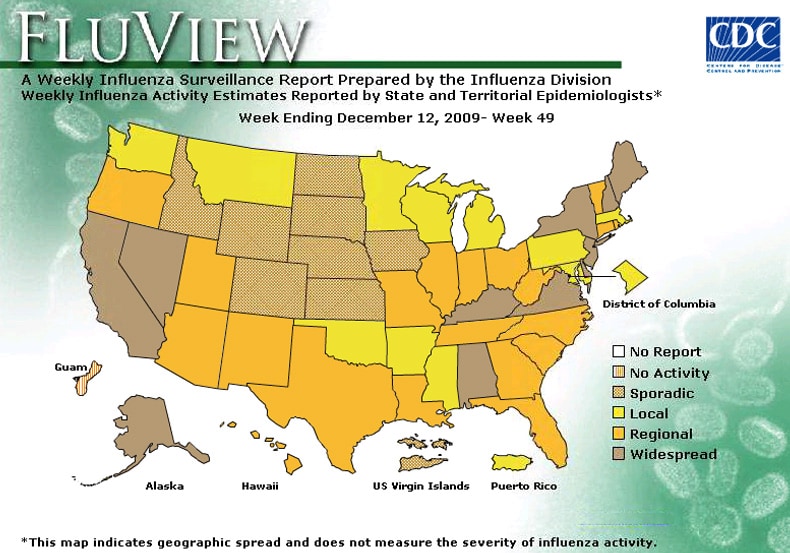
2009 H1N1 Flu: Situation Update